
You’re reading an article, scrolling through homework notes, or maybe answering a vocabulary question online when you suddenly see this sentence:
“The word chronic contains the root chron.” At first, it sounds obvious… but then comes the real question — what does the root chron actually mean? 🤔
If you’re like most people, you’ve seen words like chronic, chronology, or chronicle before, but you may never have stopped to connect the dots. Don’t worry — you’re not alone.
Once you understand this root, a whole family of English words suddenly makes sense.
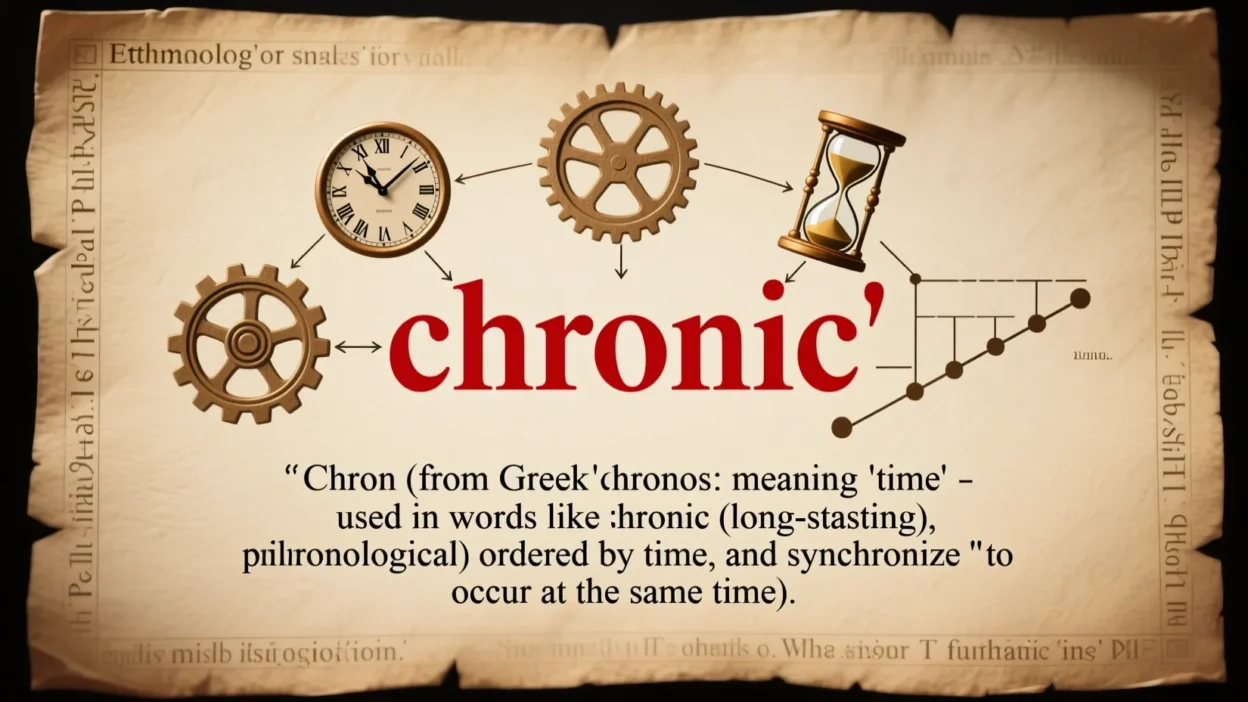
Quick Answer: The root chron means “time.” It’s a neutral, academic root used to describe things related to time, duration, or order.
What Does the Root Chron Mean in Text?
The root chron comes from the Greek word khrónos, which directly translates to “time.” Any English word that contains chron usually has something to do with time, timing, or how long something lasts.
For example:
- Chronic pain = pain that lasts for a long time
- Chronological order = arranged by time
- Chronicle = a record of events over time
When someone asks, “The word chronic contains the root chron — what does the root chron mean?” they’re really asking you to identify the core meaning behind many time-related words in English.
In short: chron = time = duration, order, or passage of time.
📱 Where Is Chron Commonly Used?
Unlike texting slang, chron is a word root, so you’ll mostly see it in educational, medical, and descriptive contexts rather than casual chats.
You’ll commonly find it in:
📚 School & academics — vocabulary, science, history 🧬 Medical terms — chronic illness, chronic conditions 🕰️ History & storytelling — chronicles, timelines 📝 Formal writing — essays, reports, textbooks
👉 Tone check:
- ✔️ Formal
- ✔️ Educational
- ❌ Not slang
- ❌ Not casual texting
Even though it’s not internet slang, understanding chron helps you instantly decode complex words — a huge advantage in reading and exams.
💬 Examples of Chron in Conversation
While people don’t usually say “chron” by itself, words built from this root show up often in everyday conversation. Here are realistic examples:
Example 1
A: why does my doctor call it chronic?
B: because it lasts a long time, not just a few days
Example 2
A: can you put these events in chronological order?
B: yeah, earliest to latest 👍
Example 3
A: this book is basically a chronicle of her life
B: makes sense, it follows everything year by year
Example 4
A: i’m always late, my time management is terrible
B: sounds like a chronic problem 😅
Example 5
A: history class is all timelines
B: yep, very chron-focused
These examples show how chron-based words naturally connect to time and duration.
🕓 When to Use and When Not to Use Chron-Based Words
Since chron is tied to formal vocabulary, context matters.
✅ When to Use
- Academic writing or homework
- Medical or scientific discussions
- Describing long-term situations
- Explaining timelines or history
❌ When Not to Use
- Casual texting with friends
- Internet slang conversations
- Jokes or memes (unless used ironically)
- Informal social media captions
📊 Context Comparison Table
| Context | Example Phrase | Why It Works |
|---|---|---|
| Friend Chat | “that’s been a chronic issue for you lol” | Casual but understandable |
| Work Chat | “This is a long-term (chronic) concern” | Professional & clear |
| School Essay | “The events are listed in chronological order” | Accurate & formal |
| “This condition has persisted over time” | Polite and precise |
🔄 Similar Roots or Alternatives to Chron
Understanding chron becomes even easier when you compare it with other time-related roots.
| Root / Word | Meaning | When to Use |
| temp | time | temporary, temperature |
| era | historical time period | history, culture |
| phase | stage of time | science, life events |
| period | length of time | academics, planning |
| timeline | sequence of events | presentations, history |
Knowing these helps you quickly identify time-based vocabulary across different subjects.
❓ FAQs About the Root Chron
What does chron literally mean?
It literally means time, coming from the Greek word khrónos.
Is chron a prefix or a root?
It’s a root word, meaning it forms the core meaning of longer words.
Is chronic always negative?
Not always. In medicine, it simply means long-lasting, not necessarily severe.
Are chronological and chronic related?
Yes. Both come from chron and relate to time, but are used differently.
Is chron used in slang?
No. It’s formal and educational, not internet or texting slang.
✅ Final Thoughts
So, if you’ve ever wondered, “The word chronic contains the root chron — what does the root chron mean?” now you have a clear, confident answer. The root chron means time, and it appears in many English words that describe duration, order, and long-term conditions.
Understanding this root instantly improves your reading comprehension, vocabulary skills, and test performance. Whether you’re studying for school, learning medical terms, or just curious about word origins, chron is one of those roots that unlocks meaning everywhere.
Once you spot it, you’ll never unsee it — time really is everywhere. ⏳
Discover More Post
What Does High Chloride Mean in a Blood Test?
What Does Opposed Mean?
What Does Collate Mean Printer for 2026
What Does It Mean If a Ladybug Lands on You