
Have you ever been scrolling through a text or comment and suddenly stop at a phrase like “vice versa”, wondering if you’re using it right—or if everyone else knows something you don’t? You’re not alone. Many people see this expression in messages, captions, or conversations and think, “Wait… does this mean the opposite? Reversed? Both ways?”
If that confusion sounds familiar, don’t worry—this guide clears everything up.
Quick Answer:
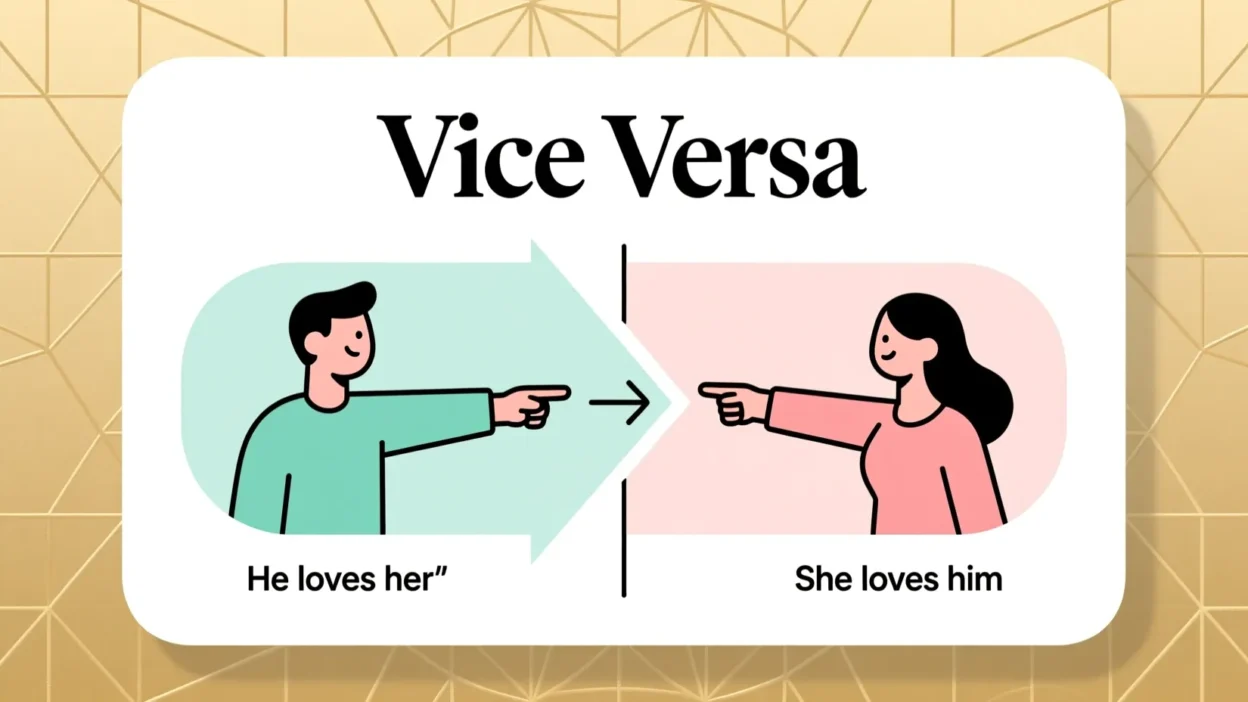
Vice versa means “the other way around” or “reversed.” It’s a polite, neutral, and slightly formal way to say that the opposite of what you just said is also true.
🧠 What Does “Vice Versa” Mean in Text?
In texting, social media, or everyday conversation, “vice versa” simply means that the reverse of a statement is also true.
It tells the other person that whatever applies to one subject also applies the other way around.
✔️ Simple Example:
- “She helps him, and vice versa.”
→ Meaning: He also helps her.
In short:
Vice versa = the other way around = reversed relationship.
It’s not slang. It’s a standard English phrase—but people use it casually in texting too.
📱 Where Is “Vice Versa” Commonly Used?
You’ll see vice versa across many communication styles because it’s clear, simple, and universal.
Most common places:
- 📱 Texting
- 💬 WhatsApp chats
- 🧢 Snapchat
- 🎵 TikTok captions
- 😄 Casual conversation
- ✍️ Work emails
- 📝 Academic writing
Tone:
- Neutral
- Polite
- Works in both casual & formal settings
- Not flirty, rude, or slangy
It’s safe for almost all situations.
💬 Examples of “Vice Versa” in Conversation
Here are realistic chat-style examples using natural texting tone:
- A: i always support u
B: same here, and vice versa 💙 - A: u help me with math, i’ll help u with english
B: deal… vice versa too 😂 - A: i love listening to your playlists
B: aww thanks, vice versa fr 😭🔥 - A: i trust u
B: vice versa. always. - A: u can text me whenever
B: same vice versa 😊 - A: i think we motivate each other
B: yup, vice versa for sure - A: u miss me?
B: lol yes… and vice versa 😳
🕓 When to Use and When Not to Use “Vice Versa”
✅ Use “Vice Versa” When:
- You’re talking casually with friends
- You want to express something works both ways
- You need a quick, neat reply
- The conversation is neutral or polite
- You’re clarifying a mutual situation
- You want to keep the message short but clear
❌ Avoid “Vice Versa” When:
- You’re writing something very formal (academic or legal)
- The context is emotionally serious or sensitive
- Someone may misunderstand the reversal
- You need detailed explanation—not a shortcut
- You’re trying to be flirty or playful (it’s too formal for that)
Comparison Table
| Context | Example Phrase | Why It Works |
| Friend Chat | “we help each other, vice versa 😄” | Casual & friendly |
| Work Chat | “this supports both teams, vice versa.” | Clear, professional |
| “The benefits apply to HR and marketing, and vice versa.” | Formal & precise | |
| Romantic Chat | “i care about u, and vice versa” | Works, but slightly formal |
| Serious Topic | Avoid using “vice versa” | Needs clearer wording |
🔄 Similar Slang Words or Alternatives
If you want something shorter, more casual, or more modern, here are great alternatives:
| Phrase/Slang | Meaning | When to Use |
| Same here | I feel the same way | Friendly/casual |
| Ditto | Same as you | Short & cute |
| Mutual | We both feel it | Romantic/friendly |
| Back at you | Same to you | Playful/casual |
| Both ways | It applies both directions | Everyday chats |
| Reversed | Opposite is also true | Clear but less casual |
❓ FAQs About “Vice Versa”
1. Is “vice versa” slang?
No. It’s a standard English phrase—but people often use it in texting.
2. Is it flirty?
Not really. It’s neutral.
But depending on the message (like “i miss u… vice versa 😳”), it can feel romantic.
3. Is it formal or casual?
Both. It’s versatile.
4. Is there an abbreviation for it?
No, people don’t shorten it like “vv” in normal texting.
5. Does it literally mean “the opposite”?
Not exactly—more like “the other way around,” meaning your statement applies both ways.
📝 Conclusion
Vice versa is one of those phrases that sounds fancy but is actually super simple. Whether you see it in a text, TikTok caption, or a work email, it just means “the other way around” or “it works both ways.” You can use it when talking about mutual feelings, shared actions, reversed situations, or anything that applies equally to both sides.
It’s clear, polite, and fits almost any conversation—making it one of the easiest expressions to add to your texting vocabulary.
Now that you know what vice versa means, you’ll not only understand it anywhere you see it—but you can use it naturally and confidently too.